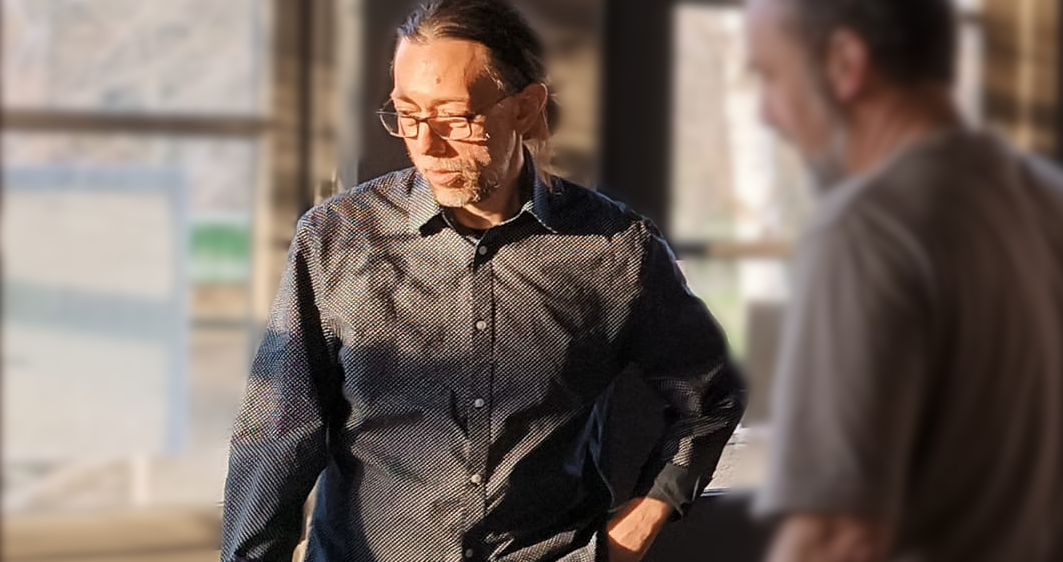
Romanian-born American artist and poet Gene Tanta moves between painting, poetry, and translation to explore color, migration, and the politics of language. His practice treats translation as a material condition: an exchange between image and text, between the conceptual commons and interior life. Across media, he asks how we stay connected without losing ourselves, and how color, memory, and language negotiate new forms of care.
Shaped by the collectivism of Eastern Europe and the individualism of the American academy, Tanta’s work lives within the ways structures of power—nepotism among them—are reimagined by desire lines of freedom. From these passages emerge questions of belonging and autonomy: how much of the self must yield to share, and how much must resist to remain whole. These questions drive his sustained studio practice and international exhibition, including at WASP Working Art Space and Production in Bucharest and during a four-month residency in Timișoara. A two-time Fulbright grantee to Romania, Tanta holds an MFA from the University of Iowa and a PhD from the University of Wisconsin–Milwaukee, and has taught at Columbia College Chicago and the University of Iowa.
Across painting, poetry, translation, and public exchange, Tanta’s work gathers at a charged threshold: where language enters the body, where memory becomes color, and where play reshapes what we inherit.
Gene Tanta
“... how much of the self must yield to share, and how much must resist to remain whole.”

Tanta’s practice begins with the relationship between shape and color: form holding color, color altering form, each adjusted through repetition and restraint. His written compositions follow a parallel path, where music moves toward meaning through shifts in diction, rhythm, and pressure. Across sustained cycles of painting, writing, and printmaking, he enters these relationships body-first and stays with them long enough for the work to present its meaning.
Practice
Mediums
Painting, works on paper, books, editions
Themes
Memory, translation, torsion
Methods
Expressive line, washed fields, letterforms
Studios
Mt. Zion, Urbana, Chicago — visits by request
Availability
Paintings and fine-art prints by inquiry
Studio
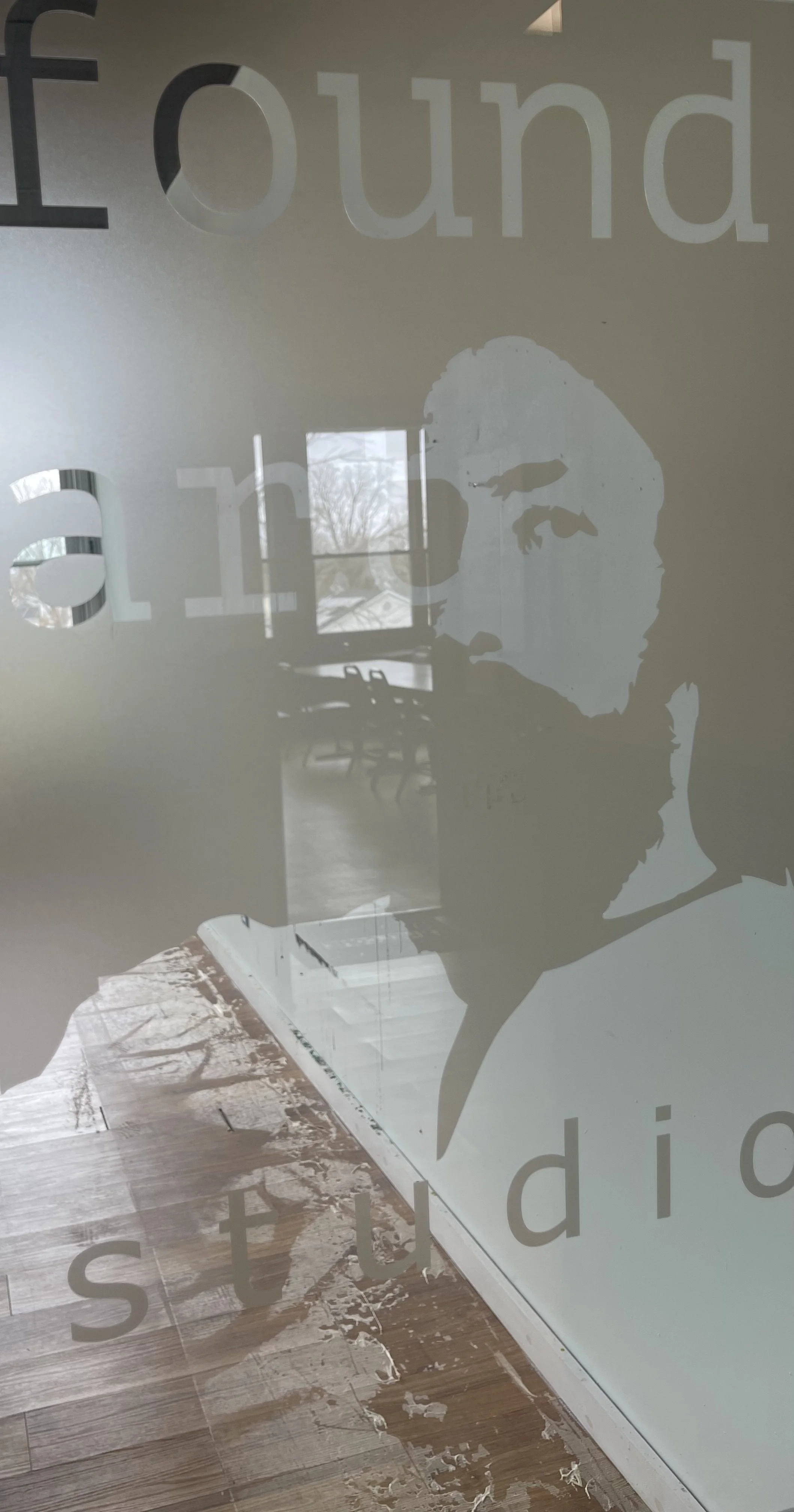
Found Art Studio is the mobile physical studio and public-facing arm of Gene Tanta’s practice. It gathers residencies, workshops, educational projects, access initiatives, studio visits, and temporary working sites under one flexible studio name. Instead of naming a single address, it names a way the work moves: through making, teaching, hosting, gathering, and exchange.
Related digital work lives separately at LogicHum.
Press
Selected publications, features, and presentations
-
Critical essay on Gene Tanta's poetry, 2010."Accessible to everyone… both aesthetic object and social content."
-
Featured visual artist, juried international art journal. Back cover.
-
Featured visual work, university literary journal.
-
Featured artist, online literary and arts magazine.
-
Cover art, UK independent poetry press.
-
Cover art, US independent literary press.
Selected CV
Gene Tanta
Education
- 2009
- PhD, University of Wisconsin–Milwaukee (Creative Writing: American Poetry, Dada, Surrealism)
- 2000
- MFA, University of Iowa (Poetry; 22 grad hrs in Painting, Drawing, Printmaking)
- 1998
- BA, Northern Illinois University (Painting & Drawing)
Solo Exhibitions
- 2023
- How do you say “patronizing” in Romanian?, Casa cu Iedera, Timișoara, RO
- 2017
- Face to Face, Madden Arts Center, Decatur, IL
Selected Group Exhibitions
- 2026
- Summer Group Exhibition, Springer Cultural Center, Champaign, IL
- 2024
- Arts in Central Park, Decatur, IL
- 2023
- And What Art Can Do About It, WASP Working Art Space and Production, Bucharest, RO
- 2020
- Alive to Interpretation, SAA Collective, Springfield, IL
- 2018
- The State of Our Shared Land, St. Louis Artists’ Guild, St. Louis, MO
- 2018
- Visceral and Visionary, Alfa Art Gallery, New Brunswick, NJ
- 2017
- A Show of Heads, Limner Gallery, Hudson, NY
- 2007
- I heart America and America hearts me, Old Gold Exhibition & Events, Chicago, IL
- 2000
- Sin Nombre, Galeria Punto y Linea—Arte Contemporaneo, Oaxaca City, MX
Residencies
- 2024–2026
- Found Art Studio, Heroic Art Center, Mt. Zion, IL
- 2022–2023
- Baraka Artist Residency, Timișoara, RO
- 2017–2018
- Enos Park Visual Artists Residency, Springfield, IL
Awards, Grants & Fellowships
- 2022–2023
- Fulbright American Scholar, Timișoara, RO
- 2012–2013
- Fulbright American Scholar, București, RO
- 2011–2012
- Community Arts Assistance Program (CAAP), City of Chicago
Representation
- Romania
- BARAKA Artist (c/o Mihai Toth), Popa Șapcă 5, Timișoara 300086, RO
- United States
- Direct inquiries to the studio
Collections
- Selected
- Galeria Punto y Linea—Arte Contemporaneo, Emmanuel d’Alzon Library, and private collections in the United States, Romania, Canada, and Mexico.
Publications
- 2013
- Memoirs and Dreams (editor), Fulbright Romania
- 2011
- Cosimo & the Queen’s Peach (with Peter Hughes), Knives Forks and Spoons Press
- 2010
- Unusual Woods, BlazeVOX [books]
- 2010
- XPMK: An Illuminated Chapbook, Cartographer Electric
- 2010
- Last Psalm, translations of Constantin Acosmei from the Romanian, Beard of Bees
- Selected
- Selected journals include EPOCH, Ploughshares, Circumference, Exquisite Corpse, and The Laurel Review.
Public Programs, Talks & Symposia
- 2013
- Organizer and host, Identity and Form in Contemporary Innovative Poetry: Symposium and Roundtable, University of Bucharest, RO
- 2010
- Chair, Immigrant Poetry: Aesthetics of Displacement, Association of Writers & Writing Programs (AWP) Conference
FAQ
Who is Gene Tanta?
Gene Tanta is a Romanian-born American artist and poet working across painting, poetry, translation, and public exchange. A two-time Fulbright grantee to Romania, he holds an MFA from the University of Iowa and a PhD from the University of Wisconsin–Milwaukee. His work explores color, migration, memory, and the politics of language.
Are paintings available?
Selected paintings and works on paper may be available by inquiry. Availability changes as works move between the studio, exhibitions, collections, and ongoing bodies of work. For acquisitions, studio visits, or specific works, please send a note through the contact form.
Are prints and editions available?
Prints, editions, publications, and related studio works are developed selectively. Some works may be available directly, while others are offered by inquiry or through small-run releases. Editions extend the studio practice through forms that can circulate beyond a single exhibition or private collection.
Can I visit the studio?
Studio visits are available by request when there is a clear fit with the work. Curators, collectors, writers, educators, students, and collaborators are welcome to send a note through the contact form with a short description of the context and timing.
What is Found Art Studio?
Found Art Studio is the mobile physical studio and public-facing arm of Gene Tanta’s practice. It gathers residencies, workshops, educational projects, access initiatives, studio visits, and temporary working sites under one flexible studio name. Instead of naming a single address, it names a way the work moves: through making, teaching, hosting, gathering, and exchange.
What is LogicHum?
LogicHum.com is a separate project space for Gene Tanta’s related digital work, including apps, games, tools, AI systems, and other interactive forms. GeneTanta.com remains the home for paintings, works on paper, books, editions, biography, CV, and the public-facing art practice.
Do you take commissions or collaborations?
Commissions and collaborations are considered when there is a strong fit with the work. This may include paintings, texts, educational projects, curatorial or editorial projects, games, or experimental forms developed in dialogue with a person, site, institution, or public context. The best inquiries are specific, open, and grounded in a real relationship to the work.
How should curators, collectors, or institutions reach out?
Curators, collectors, publishers, educators, and institutions are welcome to send a note through the contact form. For exhibitions, acquisitions, studio visits, commissions, workshops, talks, press, or institutional projects, please include a short note about the context, timeline, and nature of the inquiry.